CAPE CANAVERAL, Fla. (AP) — The people who toiled night and day to put astronauts on the moon during Apollo are thrilled that NASA is finally going back. They just wish these Artemis moonshots had happened sooner while more of Apollo’s workforce was still alive.
Now in their 80s and 90s, the dwindling survivors of NASA’s greatest generation would also like to see more enthusiasm for Artemis.
So few of them are left from the original 400,000 that no reunion is planned to celebrate the upcoming Artemis II flight around the moon by four astronauts as soon as April 1. Those living near Florida's Kennedy Space Center will watch the launch from their backyards.
“Because it was the first time, there was an energy. There was a passion that probably is not exactly the same today and hasn’t been for a while,” said Charlie Mars, 90, who worked on Apollo’s command and lunar modules and helped establish the American Space Museum in nearby Titusville.
Retired engineer JoAnn Morgan is still fuming that the last three Apollo moon landings were canceled under President Richard Nixon’s watch because of budget cuts, risk concerns and shifting priorities. She was the lone woman inside launch control when Apollo 11’s Neil Armstrong, Buzz Aldrin and Michael Collins rocketed to the moon in 1969. Three years later, Apollo 17 closed out the grand era.
“I’m just trying to stay alive so I can see us actually get back and step foot on the moon,” she said. “I’m 85 and still feeling cheated after 53 years.”
Morgan isn’t the only one frustrated with NASA’s — and the nation’s — dawdling.
“It’s a good thing I’m not in charge,” Mars said, “because I would be out there beating the bushes and whipping up on people to get moving.”
One big difference this time are all the women in key roles.
NASA’s Artemis launch director is Charlie Blackwell-Thompson. The Artemis II crew includes Christina Koch, who holds the record for the longest single spaceflight by a woman — 328 consecutive days in orbit.
“It will be even greater when they actually have a woman who plants her boots on the moon,” Morgan said.
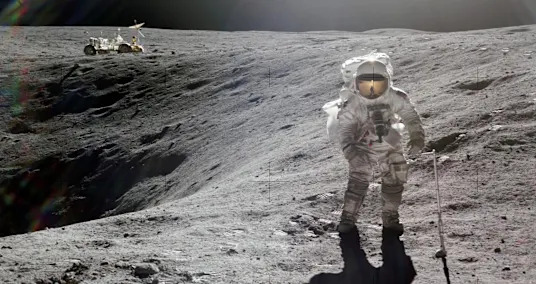
Apollo 16’s Charlie Duke points out that half the world’s population was not yet born when he walked on the moon in 1972.
NASA’s new administrator Jared Isaacman, a tech billionaire who paid his own way to space twice, is one of them.
Apollo’s old-timers are heartened that the 43-year-old Isaacman is accelerating the pace of Artemis launches to more closely match Apollo’s speed and safety record. Artemis has been trudging along at a once-every-three-years flight rate, which Isaacman deems unacceptable.
He’s added a test flight in orbit around Earth to practice docking with lunar landers before they’re used to put astronauts on the moon. And last week, he released a blueprint for a moon base that, along with a battalion of lunar drones and rovers, is expected to cost $20 billion over the next seven years.
NASA’s self-described “moon base guy,” Carlos Garcia-Galan, promises “cool cameras” on everything to ramp up excitement.
In the near term, the overriding goal is to beat the Chinese to the lunar surface. NASA aims to land astronauts in 2028, China by 2030.
The U.S. trounced the Soviet space program in the first race to the moon, landing 12 astronauts from 1969 through 1972.
John Tribe, 90, who managed spacecraft propulsion for Apollo, considers NASA's revised Artemis plan “a whole lot more sensible.”
“The other approach was ridiculous,” Tribe said. “Whether we’re going to beat the Chinese back, I don't know.”
Apollo 9's Rusty Schweickart also likes the refashioned Artemis. As for topping Apollo's excitement, though, good luck.
“We can all recall Columbus,” Schweickart said in an email, but who can remember “who came along 50 years afterward?”
One of only four moonwalkers still alive, Duke anticipates the thrill of Apollo will return once Artemis astronauts start landing, especially for the younger crowd that missed out before.
“If the first ones are successful and we start landing at the south pole,” Duke said, “I think millions are going to be watching that. I know I will if I’m still here.”
___
The Associated Press Health and Science Department receives support from the Howard Hughes Medical Institute’s Department of Science Education and the Robert Wood Johnson Foundation. The AP is solely responsible for all content.
LATEST POSTS
- 1
 The Most Rousing Ladies Business visionaries of Today
 - 2Starfront Observatories: A haven for distant stargazers
- 3Step by step instructions to Integrate Lab Precious stones into Special Adornments Pieces
- 4Mossad unveils network of Hamas terror infrastructure across Europe
- 5Allow Innovative Progressions To have a Massive Effect



- British Columbia's Secret Lakeside Town With Hot Springs Is 'An Oasis Of Arts, Culture And Relaxation'
- Dozens of hidden star streams found in the outskirts of our Milky Way galaxy
- Monetary Strengthening: Assuming Command over Your Cash
- Remarkable Spots for Hot Air Swelling All over The Planet
- Closets for Your Room: Plan and Utility Features
- Pick Your #1 Sort Of Espresso
- Find the Historical backdrop of Common liberties: Advancing Equity and Equity Around the world
- 5 Morning Schedules That Stimulate Your Day
- These are the Fastest Italian Sports Cars